Short Courses

Short Course#1

Title: Fundamentals of Geologic Storage-Based Carbon Dioxide Capture, Utilization, and Storage (CCUS) Strategies

Date/Time: Sunday- April 12, 2026 / 9:00am-5:00pm

Location: Conference Hotel

Description: This short course presents the fundamental scientific and engineering principles of subsurface CO₂ injection and geologic storage within the framework of carbon capture, utilization, and storage (CCUS). It covers the capture of anthropogenic CO₂ and its injection into depleted oil and gas reservoirs and deep saline formations for enhanced oil, gas, and water recovery, as well as long-term geologic CO₂ storage.

The course emphasizes the application of petroleum industry expertise in subsurface characterization, drilling, reservoir engineering, and multiphase and reservoir-scale flow behavior to the design and implementation of technically sound and commercially viable CCUS projects. Key project elements are discussed, including business drivers, risk assessment, monitoring and verification concepts, regulatory and permitting considerations, representative field case studies, technical and non-technical challenges, and future deployment pathways.

Designed as an introductory professional short course, this offering is intended for petroleum engineers, geoscientists, early-career professionals, researchers, and graduate students seeking practical exposure to geologic CO₂ storage (GCS)-based CCUS projects. It is also relevant for regulators, policymakers, and other stakeholders requiring a technically grounded overview of CCUS concepts and applications.

Leader(s): Dayanand Saini, Ph.D.

Bio(s): Dr. Dayanand Saini is a petroleum engineer, academic, researcher, inventor, and entrepreneur with over twenty years of professional and academic experience. He earned his Ph.D. in Petroleum Engineering from Louisiana State University, Baton Rouge, and is a tenured Full Professor of Physics and Engineering at California State University, Bakersfield (CSUB). He also serves as Director of Technology Innovation and Commercialization at CSUB, where he oversees intellectual property development, patenting, licensing, and industry partnerships.

Before joining CSUB, Dr. Saini served as Research Manager (Reservoir Engineering) for the U.S. Department of Energy–funded Plains CO₂ Reduction (PCO2R) Partnership, led by the Energy & Environmental Research Center at the University of North Dakota. He supported multiple large-scale CO₂-enhanced oil recovery and geologic storage demonstration projects. Earlier, he worked as a Reservoir Engineer with Oil and Natural Gas Corporation (ONGC), India. Dr. Saini is the author of two SpringerBriefs on geologic CO₂ storage and CO₂–oil miscibility, has published extensively in peer-reviewed journals, is a long-standing member of the Society of Petroleum Engineers (SPE), and is actively commercializing his patented dual-purpose CO₂ capture and produced-water treatment technology.

Short Course#2

Title: Spatial Science Fundamentals for Oil & Gas Professionals

Date/Time: Monday- April 13, 2026 / 9:00am-4:00pm

Location: Conference Hotel

Description: This 1-day (6-hour) short course introduces oil and gas professionals to practical ArcGIS Pro workflows. Participants will build core proficiency in navigating ArcGIS Pro, working with coordinate systems, managing and organizing data, performing foundational spatial analysis, and producing clear, defensible map deliverables. Exercises use real-world California public regulatory datasets (e.g., wells, fields, administrative boundaries, and related compliance layers), with an emphasis on hands-on techniques commonly used for permitting support, compliance mapping, operational planning, and technical communication.

Leader(s): Cole Heap, P.G.

Bio(s): Cole Heap, P.G., brings over a decade of expertise in the energy sector, specializing in geologic interpretation, well development, and earth modeling. As a licensed Professional Geologist in California and Wyoming, he collaborates with regulatory agencies, IT professionals, and consulting firms to achieve what often seems like the impossible. Additionally, he serves as adjunct faculty at multiple colleges throughout California, instructing courses in geology, geography, and GIS. With a Bachelor's and a Master's degree in Geology, as well as a Master's in Geographic Information Science and Technology, Cole's dedication to continuous learning and knowledge sharing enriches both industry projects and educational endeavors.


Short Course#3

Title: Reservoir Pattern Surveillance using Streamlines

Date/Time: Monday- April 13, 2026 / 9:00am-4:00pm

Location: Conference Hotel

Description: Streamline-based (SL) flow simulation has traditionally been viewed as a modeling approach that is complementary to other flow simulation methods.  However, streamlines are also ideally suited to the much more common application of reservoir pattern surveillance of mature floods.  Because the streamline paths themselves yield well drainage regions and well-pair allocation factors, engineers can easily reduce complex production data down to the reservoir pattern level.  Streamline based patterns then highlight areas of fluid cycling vs efficient use of injected fluids, or longer term metrics such as remaining oil in place (ROIP) from material balance.  Furthermore, knowing well pair connections and pattern efficiencies also provides the basis of flood optimization via updated well rate targets.  The elegance of a streamline-base surveillance model is that it accounts for historical flow rates, well geometry, and any level of field geology, meaning it is not subject to an engineer's "best guess" of implied patterns.  These models can be quick to build and easy to run, yet are surprisingly robust when compared with more detailed history match flow simulation models.  In fact, given the ease with which streamline-based surveillance models can be constructed, any large mature water or miscible flood should have a streamline-based surveillance model, as another way to interpret the production/injection data.

Purpose of course: We outline the theory of streamline-based surveillance. How to build a streamline-based surveillance model in studioSL.  How to build a well-rate target workflow of a surveillance model in floodOPT. How to forecast a surveillance model.

Leader(s): Marco R Thiele

Bio(s): Dr. Thiele is co-founder and president of Streamsim Technologies and Adjunct Professor in the Department of Energy Science and Engineering at Stanford University. He received his PhD from Stanford University in 1994 and his Masters and Bachelors from the University of Texas at Austin in 1989 and 1986 respectively, all in Petroleum Engineering.

Dr. Thiele is a member of the Society of Petroleum Engineers (SPE) since 1985 and a Distinguished Member of SPE since 2012.  He is the recipient of the 2012 SPE Lester C. Uren Award, the 2010 SPE “A Peer Apart” Award, the 1996 SPE Cedric K. Ferguson Medal.

Dr. Thiele’s research interests revolve around the use of streamline-based reservoir surveillance and simulation technology to solve outstanding problems associated with managing and optimizing IOR/EOR floods.

Short Course#4

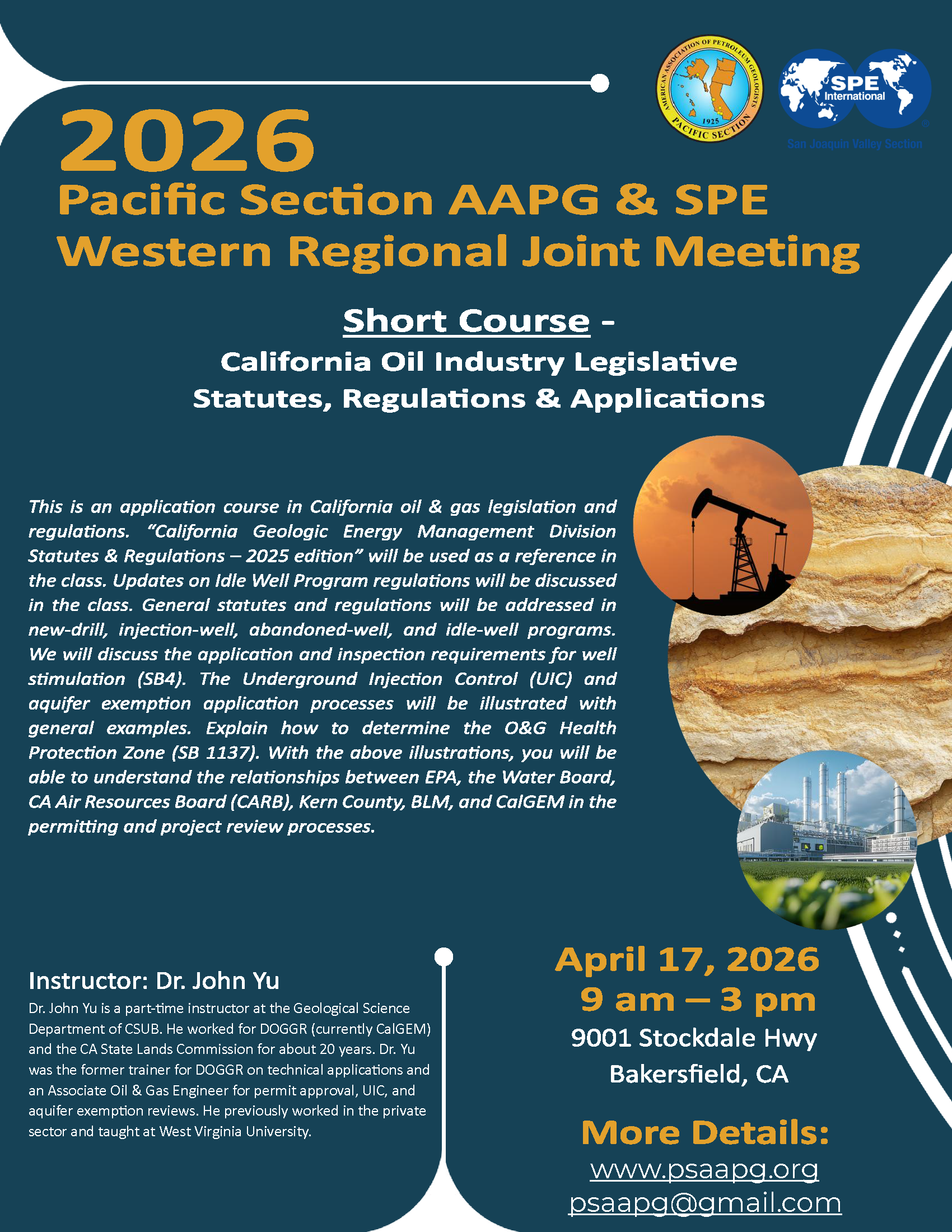
Title: California Oil Industry Legislative Statutes, Regulations & Applications

Date/Time: Friday- April 17, 2026 / 9:00am-4:00pm

Location: Offsite (California State University, Bakersfield (CSUB), 9001 Stockdale Highway, Room 336 in Science II). See the location map below. Discounted parking permit ($2) to be paid by the attendee.

Course Outline:

1.      Functions of the California Geologic Energy Management Division

2.      BLM, CARB, Kern County & City permits for oil & gas leases

3.      Regional Water Board, State Water Board, and EPA involvement

4.      Oil & gas well permits – new drill, workover, and abandonment

5.      Field inspection requirements related to well permits

6.      Aquifer exemption, underground injection control (UIC) applications & approval processes

7.      Update on UIC regulation & the impacts on your operation

8.      Idle Well Program and update on the newly released regulation in the program

9.      Well stimulation application and inspection requirements

10. Determination of CA Oil & Gas Health Protection Zones (HPZ) and active receptor: SB 1137

11. Future Oil Spill Prevention SB 237

12. Questions & answers


Course Description:

This is an application course in California oil & gas legislation and regulations. “California Geologic Energy Management Division Statutes & Regulations – 2025 edition” will be used as a reference in the class. Updates on Idle Well Program regulations will be discussed in the class. General statutes and regulations will be addressed in new-drill, injection-well, abandoned-well, and idle-well programs. We will discuss the application and inspection requirements for well stimulation (SB4). The Underground Injection Control (UIC) and aquifer exemption application processes will be illustrated with general examples.  Explain how to determine the O&G Health Protection Zone (SB 1137). With the above illustrations, you will be able to understand the relationships between EPA, the Water Board, CA Air Resources Board (CARB), Kern County, BLM, and CalGEM in the permitting and project review processes.


Instructor:

Dr. John Yu is a part-time instructor at the Geological Science Department of CSUB. He worked for DOGGR (currently CalGEM) and the CA State Lands Commission for about 20 years. Dr. Yu was the former trainer for DOGGR on technical applications and an Associate Oil & Gas Engineer for permit approval, UIC, and aquifer exemption reviews. He previously worked in the private sector and taught at West Virginia University.

Location: CSUB, map here